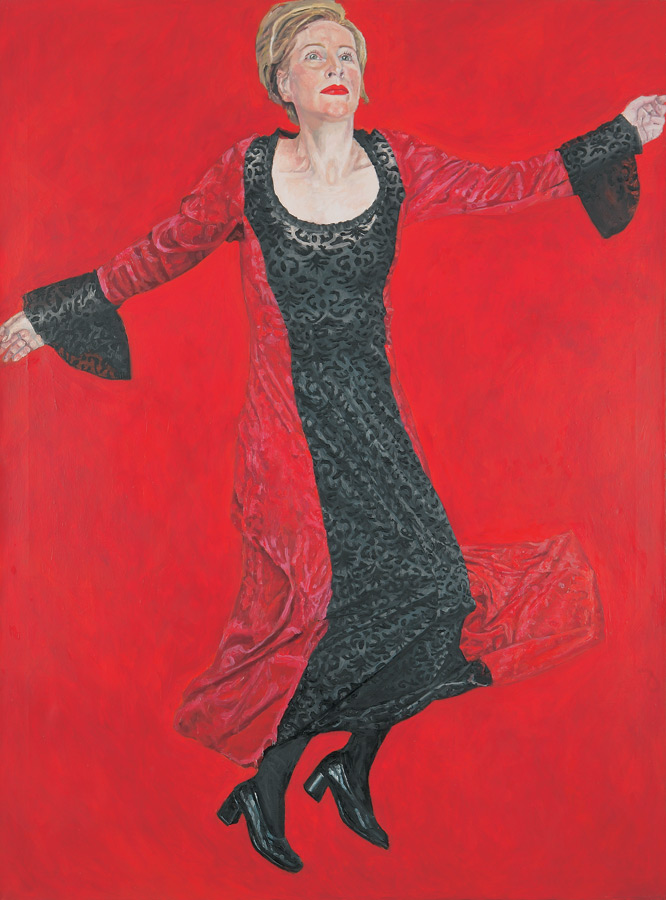
Ithought I had grasped the nature of what I was dealing with. Illusion and Scene seemed to be appropriate names for what I did when painting. I must now confess – utterly without reluctance, because one is happy when he discovers something new – that Concept and Method are more important properties of art after all. I feel somewhat uneasy, however, about the fact that time is fleeting. Recently I had to visit an optician because I can not see clearly what I am drawing any more, and I gave up reading long ago; my teeth are made of porcelain for quite a while now, and I am beginning to notice a slight foul smell on myself. But even without spectacles I can see that my painings are getting better. I don't know if this is due to the fact that I have given precedence to Concept and Method over Illusion and Scene, or even to the fact that these properties are permeating each other. Anyway, if I am lucky enough to stay strong and healthy for the next couple of years, I should make some really good paintings.
Perhaps I should have formulated this in the following manner:
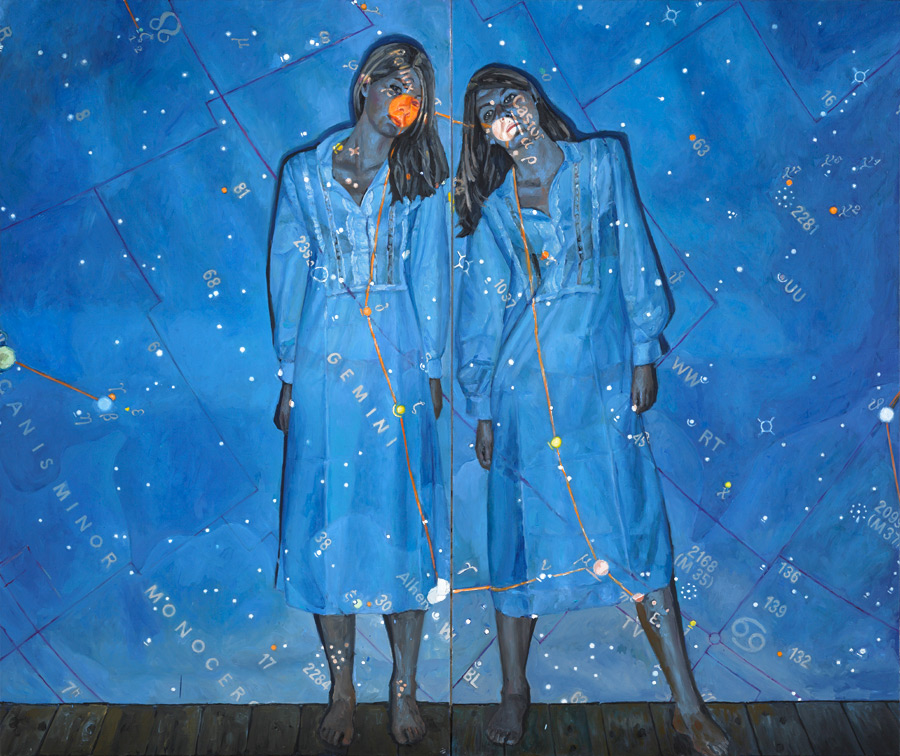
Once upon a time there was a white nightgown at Humana. Humana is a second-hand store near Frankfurter Tor. I sent Ernestine there to buy a white piece of clothing which she would wear as I projected a star chart onto her. I wanted the scene to look as if it were night, but at the same time it should be obvious that this was only a projection of the starry sky on the model. I like to move in this space between the painted image and the inner one, which is induced by it. Maybe this is what Luc Tuymans was referring to when he said that he regarded "this small space between the painting and its interpretation as the only possibility". Although this is nothing new. In Caravaggio's "Entombment of Christ", for example, one can see clearly that the whole scene is just a pose, an illusion which is supposed to induce in us a real image of the tragic moment. Well – to make it short, Ernestine bought exactly this nightgown at Humana for 5 euros.